
Stereo enhancement is one of those topics that can quickly become controversial in audio production.
Some stereo processors sound artificial, phasey or overly exaggerated. Others widen the signal so aggressively that the mix starts to lose focus and punch. Finding a stereo enhancement tool that actually sounds musical is surprisingly difficult.
A few years ago, SPL introduced the original SPL BiG, a compact stereo width processor that quickly became very popular in the pro audio community. The concept became so successful that it even received an official software version through Plugin Alliance.
Now SPL expanded the idea into a full rack unit:
the SPL BiG Studio.
And after spending some time with it, I have to say that it still remains one of the most interesting and musical stereo enhancement tools I’ve used.
What Is the SPL BiG Studio?
At its core, the SPL BiG Studio is a stereo enhancement processor designed to increase:
- stereo width
- depth perception
- spatial positioning
- and overall dimensionality
without making the mix sound unnatural.
Unlike many stereo wideners that focus purely on left/right expansion, the BiG also manipulates the perceived front/back positioning of elements inside the stereo image.
That is where the processor becomes especially interesting.
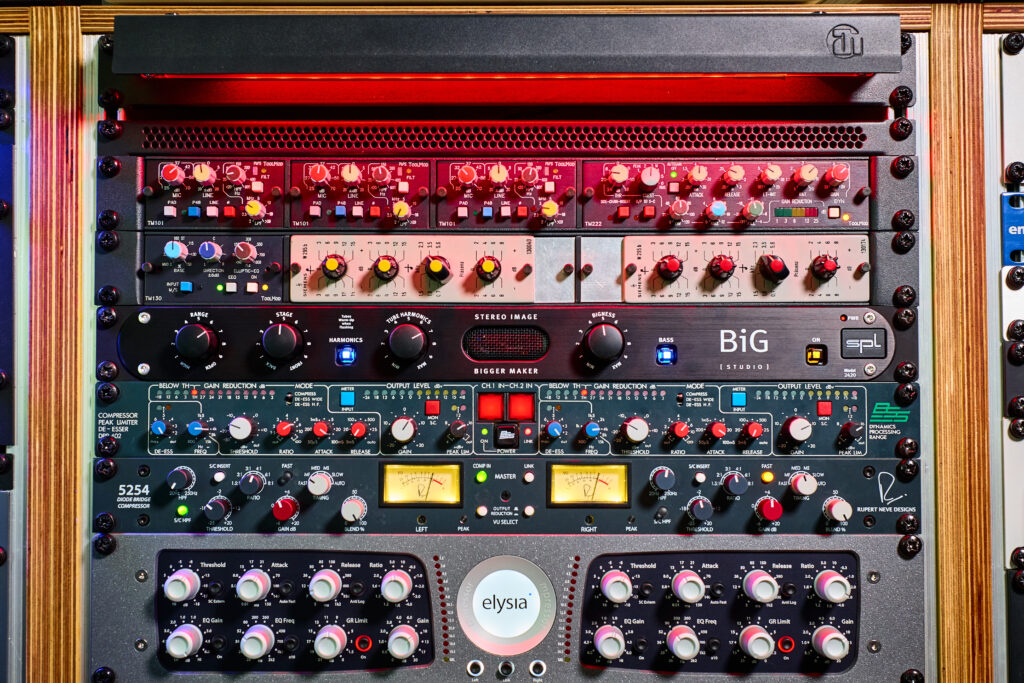
The Main Controls
The workflow of the BiG Studio remains beautifully simple and immediate.
Range
The Range control determines the frequency spectrum that is affected by the processing.
You can either:
- focus primarily on the high frequencies
- or gradually open the processing into the midrange
This is extremely useful because widening low mids too aggressively can quickly destabilize a mix.
Stage
The Stage control affects the perceived depth positioning of the stereo image.
Instead of simply widening the signal, elements start to feel:
- more distant
- more spacious
- or more upfront
depending on the settings.
This psychoacoustic aspect is what gives the BiG its very unique behavior.
Bigness
The Bigness control determines the overall amount of the effect.
This is the heart of the processor and where the stereo field starts to open up dramatically.
What I personally enjoy is that the effect remains surprisingly musical even at fairly aggressive settings.
Bass
The Bass section adds additional low-end weight and density.
Especially in electronic music, this can create a very satisfying sense of fullness and physicality.
The New Tube Harmonics Section
The biggest addition to the BiG Studio compared to the original version is the new Tube Harmonics stage.
This section introduces additional harmonic overtones that make the signal feel:
- richer
- more detailed
- more dimensional
At first it can almost feel like a treble enhancement, but the effect is actually far more complex.
The harmonics create a subtle sense of presence and “grab” without becoming harsh or artificial.
What surprised me most is how organic the harmonics sound. They feel less like an obvious saturation effect and more like a natural extension of the source material.
Especially on synths and textured electronic elements, the result can become incredibly immersive.
Why It Works So Well on Synth Groups
One thing I increasingly enjoy is using the BiG Studio not necessarily on the full mix bus, but on:
- synth groups
- stems
- atmospheric elements
- textured stereo layers
This allows me to create a separate sense of width and depth for certain groups inside the arrangement.
Instead of making the entire mix wider, I can selectively reposition elements in the stereo field and create a more three-dimensional arrangement.
That workflow feels incredibly musical.
A Psychoacoustic Processor
The SPL BiG Studio is difficult to explain purely technically because so much of its behavior is psychoacoustic.
You often don’t fully notice what it is doing while it is active.
But the moment you bypass it, the mix suddenly feels:
- flatter
- smaller
- less immersive
That is usually the sign of a very well-designed processor.
Final Thoughts
The SPL BiG Studio is not just another stereo widener.
It feels more like a spatial enhancement tool that helps create:
- depth
- dimension
- openness
- and movement
in a very organic way.
Combined with the new Tube Harmonics stage, the BiG Studio becomes an extremely musical processor for modern productions, especially in dense electronic arrangements where spatial positioning is crucial.
For me personally, it shines most when used creatively on groups and stems rather than simply inserted across every full mix.
And honestly, it’s one of those processors that becomes surprisingly addictive once you start hearing what it does inside a mix.