
This article expands on the first episode of my Home Studio Acoustics Guide, where I explain why room dimensions matter and compare two possible studio rooms using REW simulations.
If you prefer watching instead of reading, you can watch the full episode here:
Choosing the Right Room for Your Studio
Before buying monitors, acoustic panels, or expensive gear, the most important decision for any home studio happens long before the first piece of equipment enters the room.
It’s the room itself.
Room dimensions determine how sound behaves, how bass builds up, and ultimately how reliable your monitoring environment will be.
In this first episode of the Home Studio Acoustics Guide, I want to demonstrate how dramatically room proportions influence acoustics by comparing two example rooms using REW (Room EQ Wizard) modal simulations.
Both rooms have roughly the same volume — yet their acoustic behaviour is very different.
Key Takeaways
If you’re setting up a home studio, remember these key points:
• The room itself is the most important part of your studio
• Room dimensions determine how bass behaves
• Poor room proportions create strong resonances
• Even modal distribution leads to better monitoring accuracy
• Acoustic treatment works best when the room proportions are reasonable
• Measurement tools like REW help you understand and improve your room
Why This Series Exists
Another important reason I started this series is the reality many musicians and producers face today.
Studio space is becoming increasingly scarce.
Rental prices in many cities are rising dramatically, and dedicated studio spaces are often simply not affordable anymore. Many producers are forced to work from:
• bedrooms
• small apartments
• shared living spaces
• improvised home studios
Because of this, the home studio has become the new standard.
And that’s exactly why I wanted to create this guide.
My goal is to help producers understand how to get the best possible sound out of imperfect rooms. Even small or acoustically challenging spaces can be transformed into reliable mixing environments when approached with the right knowledge and tools.
You don’t need a million-dollar studio to make professional sounding music — but you do need to understand how your room behaves.
This series is meant to guide you through that process step by step.
The Physics Behind Room Acoustics
When sound waves travel through a room, they reflect off boundaries:
• walls
• floor
• ceiling
At low frequencies these reflections create standing waves, also called room modes.
Room modes occur when the wavelength of a sound matches the distance between two surfaces. When this happens, reflections reinforce each other and create resonances.
These resonances cause:
• peaks (frequencies that become too loud)
• nulls (frequencies that cancel out)
This is the main reason why untreated rooms often have very inaccurate bass reproduction.
Types of Room Modes
Room modes are generally divided into three categories.
Axial Modes
These occur between two parallel surfaces.
Examples include:
• front wall ↔ back wall
• left wall ↔ right wall
• floor ↔ ceiling
Axial modes are the strongest and most dominant modes in any room.
Tangential Modes
Tangential modes involve four surfaces.
They are weaker than axial modes but still contribute to the modal response of the room.
Oblique Modes
Oblique modes involve all six surfaces of the room.
They are the weakest modes but still influence the overall acoustic behaviour.
Why Room Proportions Matter
The goal of a good room is not to eliminate room modes — that is physically impossible.
The goal is to spread modal frequencies evenly across the spectrum.
When several room modes occur at the same frequency, they stack, creating large resonant peaks that are very difficult to control.
Well-proportioned rooms distribute modal frequencies more evenly, which results in:
• smoother bass response
• easier acoustic treatment
• more reliable monitoring
Simulation Setup (REW)
To demonstrate this, I used the Room Simulator inside REW (Room EQ Wizard).
The simulation calculates:
• axial modes
• tangential modes
• oblique modes
• frequency response at the listening position
The speakers are placed along the short wall, which is standard practice in small studios.
The listening position follows the 38% rule, placing the listening position roughly 38% into the room length — a common starting point that often avoids strong modal pressure zones.
Room A – Long and Narrow
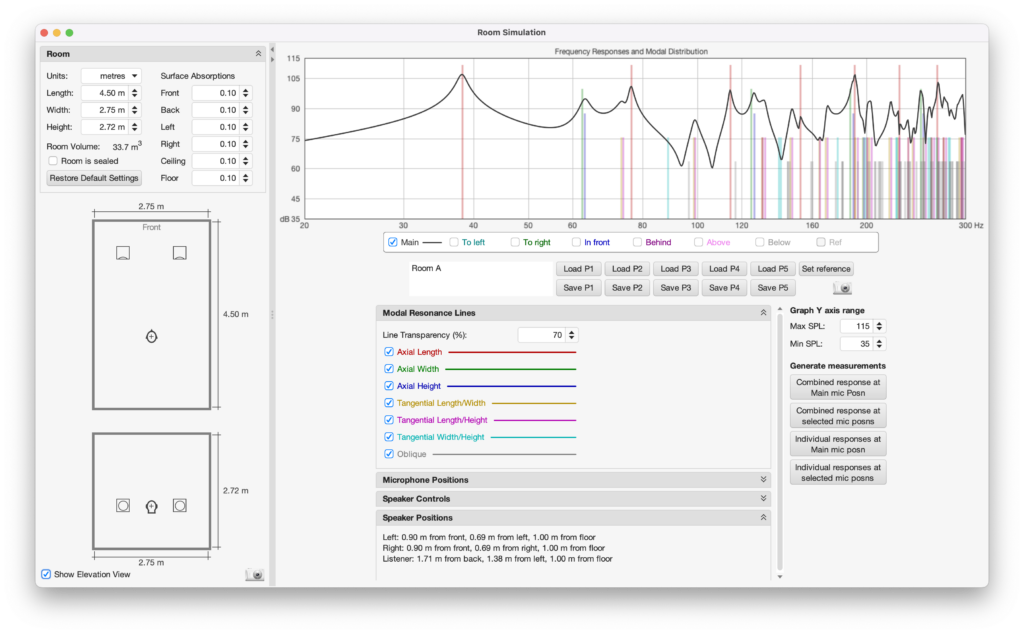
The graph shows a strong axial room mode around 38 Hz, caused by the room’s length dimension. This resonance results in a pronounced low-frequency peak and uneven bass response at the listening position. The narrow width of the room also leads to modal clustering between approximately 60 Hz and 120 Hz, which can negatively affect the perception of kick drums, bass instruments, and low synthesizer frequencie
Dimensions:
Length: 4.50 m
Width: 2.75 m
Height: 2.72 m
The simulation shows a strong resonance around 38 Hz.
This corresponds to the axial length mode of the room.
We can calculate it:
Speed of sound ≈ 343 m/s
Fundamental mode:
f = c / (2L)
f = 343 / (2 × 4.50)
f ≈ 38 Hz
This matches the simulation almost perfectly.
What This Means in Practice
A strong resonance like this causes several issues.
Bass around 38 Hz becomes exaggerated, which can lead to incorrect mix decisions.
Additionally, the narrow width (2.75 m) causes modal clustering in the 60–120 Hz region.
This range is extremely important for music production because it contains:
• kick drum fundamentals
• bass instruments
• low synth frequencies
If a room exaggerates or cancels frequencies in this range, it becomes difficult to judge the balance of the low end.
Room B – More Balanced Geometry
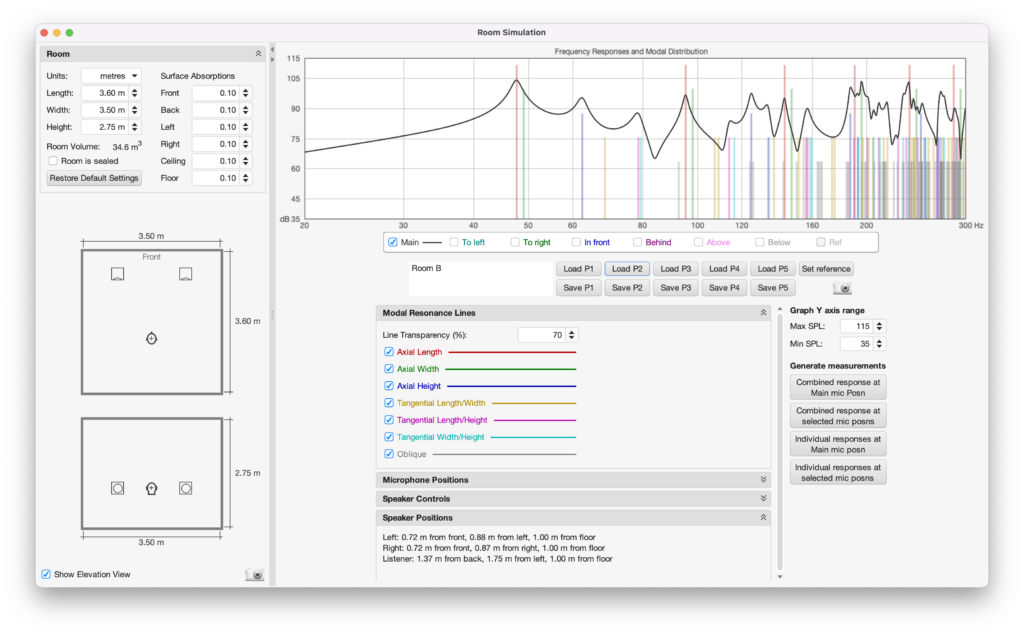
Compared to Room A, the more balanced proportions of this room result in a more even distribution of room modes. Instead of strong isolated resonances, the modal frequencies are spread more evenly across the spectrum, which generally leads to a smoother low-frequency response and makes acoustic treatment more effective.
Dimensions:
Length: 3.60 m
Width: 3.50 m
Height: 2.75 m
Even though this room is slightly smaller, the proportions are much better balanced.
The modal frequencies are distributed more evenly across the spectrum.
Instead of large isolated peaks, we see a smoother modal distribution, which is exactly what we want in a studio environment.
Why Even Modal Distribution Is Better
When modal frequencies are evenly distributed:
• no single frequency dominates the response
• acoustic treatment works more effectively
• bass trapping becomes easier
Bass traps absorb energy across a range of frequencies. If a room has very strong modal peaks, those peaks require much deeper and more aggressive treatment.
Even modal distribution makes the room much easier to control acoustically.
Why I Ultimately Chose Room A
Despite the better acoustic behaviour of Room B, I still decided to use Room A for my studio.
And the reason is something many home studio owners will immediately understand:
Neighbours.
In an apartment building, acoustics is only one side of the equation. The other is sound transmission through the building structure.
Low frequencies travel extremely well through:
• walls
• floors
• ceilings
• structural elements of the building
Even moderate listening levels can become audible in neighbouring apartments.
Because of the layout of my apartment, Room A allows me to place the speakers against a wall that does not directly share structure with neighbouring apartments.
Instead, most of the acoustic energy is directed toward:
• exterior walls
• hallways
• or rooms within my own apartment
This reduces the risk of disturbing neighbours, especially when working with bass-heavy music.
In other words, the decision was a compromise between:
• acoustic performance
• practical living conditions
• building layout
And this is a reality many home studio producers face.
The room that measures best acoustically is not always the room that works best in everyday life.
Ideal Home Studio Room Dimensions
There are several classic room ratios used in studio design.
Examples include:
Bolt Area
1 : 1.4 : 1.9
Sepmeyer Ratio
1 : 1.6 : 2.33
These ratios aim to distribute room modes evenly across the frequency spectrum.
In practice, however, most home studios cannot follow these ratios exactly because we are working with existing apartments or rooms.
This is why measurement and acoustic treatment are essential.
Why Small Rooms Are Challenging
Home studios are typically between 10 and 20 square meters, which places them in the most problematic acoustic range.
Low frequencies have very large wavelengths.
Examples:
40 Hz → ~8.6 m wavelength
60 Hz → ~5.7 m wavelength
80 Hz → ~4.3 m wavelength
These wavelengths are often larger than the room itself, which explains why bass behaves so unpredictably in small spaces.
The Role of Acoustic Treatment
Even imperfect rooms can be improved significantly.
Typical treatment strategies include:
Bass traps
Placed in corners where low-frequency pressure builds up.
Broadband absorbers
Placed at first reflection points to improve clarity and stereo imaging.
Ceiling clouds
Used to control vertical reflections between speakers and listening position.
Treatment cannot completely fix bad room proportions, but it can dramatically improve the listening environment.
What Comes Next – Episode 2
In the next episode we will look at one of the most important tools for understanding room acoustics:
REW (Room EQ Wizard).
REW is a powerful and free acoustic measurement software that allows us to:
• measure frequency response
• analyze room modes
• visualize reflections
• evaluate acoustic treatment
• optimize speaker placement
Throughout this entire series I will use REW as the main analysis tool, because it allows us to make decisions based on real measurements instead of guesswork.
In Episode 2 I will show:
• why REW is essential for studio acoustics
• how the software works
• how to measure your room
• and how we will use it throughout the entire process.
Frequently Asked Questions About Home Studio Acoustics
What are room modes?
Room modes are resonances created when sound waves reflect between parallel surfaces. These resonances cause certain frequencies to become louder while others cancel out.
Why are small rooms difficult for mixing?
Small rooms are often similar in size to the wavelength of bass frequencies, which causes strong resonances and uneven bass response.
Should studio monitors be placed on the short wall?
Yes. In most small studios, placing the monitors on the short wall allows sound to travel along the longest dimension of the room and improves stereo imaging.
What is REW used for?
REW (Room EQ Wizard) is a measurement tool used to analyze room acoustics and optimize speaker placement and acoustic treatment.